The Parlour Game and the Changing Idea of Home Leisure
Parlour game history reveals how indoor play fit household routines—and how a shared game can make an ordinary evening feel more connected today.
The common mistake in thinking about parlour games is treating them as quaint diversions from “real” leisure. Parlour game history offers a more grounded view: these games gave people in the same home a reason to gather, take turns, and make an ordinary evening feel shared. It also raises a harder question about who had time, space, and permission to play.
Home games were one option among many forms of leisure, alongside conversation, music, reading, and other pastimes. Their lasting lesson is not that every household needs a formal game night. It is that a shared room can serve as a place to do something together, not just a route between chores.
Why did parlour games fit into household routines?
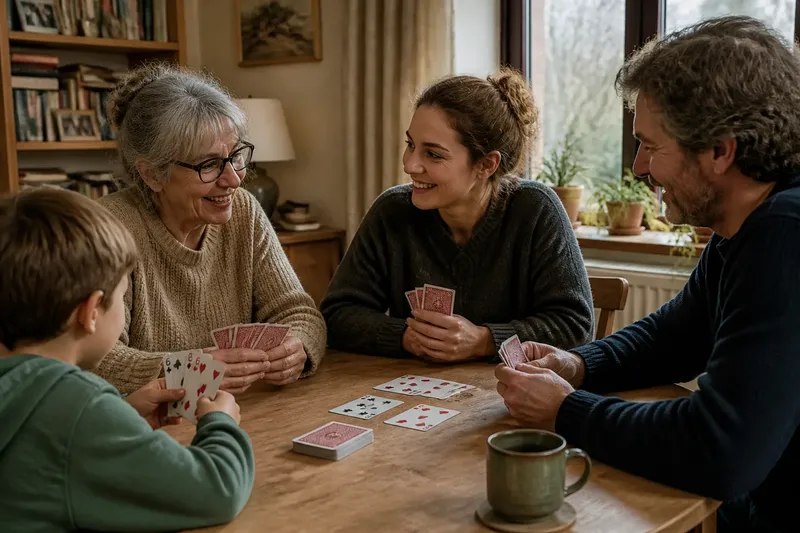
A parlour game could be played with modest supplies and furniture already at hand. A deck of cards, paper and pencil, or a spoken prompt could bring people together after a meal, during a visit, or on an evening spent indoors. There was no need to turn the room into a dedicated play space; the group only had to agree on an activity.
That made games part of home leisure rather than an outing. A card game could fit around a table, while a word or guessing game might need no cleared surface at all. The practical detail matters: play could accommodate a room’s existing use instead of asking the household to reorganize it.
Who had time and permission to join?
Home leisure was shaped by work, caregiving, household roles, and expectations attached to age and gender. Some people hosted or organized an evening; others were expected to keep domestic tasks moving. A cheerful gathering did not necessarily mean everyone had an equal chance to sit down and take part.
That imbalance can reappear in a modern household. One person may be left to find the cards, teach the rules, manage interruptions, and put everything away. Sharing play also means sharing those small tasks, so the invitation does not quietly become another job for the person who already carries the evening.
How did games shape conversation?
A game gives people something to do while they talk. Taking turns can ease the pressure to keep conversation flowing, particularly when guests are new to one another or several generations are together. Rules provide a little structure, and guesses or playful disputes give everyone something to respond to.
That structure works like a handrail on a staircase: it offers something steady to hold while people find their footing together. Unlike entertainment playing in the background, a group game lets each person’s attention affect what happens next. A turn, a guess, or a shared decision becomes part of the conversation.
How did home games adapt to different rooms and occasions?
Household schedules, furnishings, and available amusements shaped which games people could play. Some indoor group games involved movement or acting; others suited a crowded room and a quieter evening. A word game could work when people wanted to talk, while cards offered clear turns and a familiar structure. No single kind of game had to replace the others.
Modern households also have competing schedules, chores, work messages, and personal screens. The historical point is not that older routines were simpler. It is that home leisure has always had to fit the practical conditions of a particular room and group.
How can parlour game history inform a shared evening now?
Start with the room and supplies already available, rather than trying to recreate an idealized parlour. Decide whether the group has a clear table, a quiet corner, or only a few minutes before another household task. Then choose a game whose setup fits that situation: cards for a table, a spoken guessing game for a room with no clear surface, or a word game for people who want to keep talking.
Say a household has a small table, one deck of cards, and adults and children who usually drift to separate screens after dinner. They agree to play a familiar matching game, with a child dealing and an adult explaining only the rules needed to start. The resulting choice is observable: if players take turns and respond to one another, they can continue; if someone needs to leave for a household task, the group can pause or stop without treating that as a failure.
- Check whether the table is clear; if it is, choose a card or board game, and if it is not, choose a spoken word or guessing game.
- Check how much explanation the group is willing to hear; if people are ready to learn, introduce a new game, and if not, choose one with familiar rules.
- Check whether anyone needs to leave soon; if the group has an uninterrupted stretch, begin a longer game, and if not, choose a short round that can end cleanly.
- Check who is handling the supplies; if one person is doing every setup task, ask someone else to deal or gather pieces, and if no one is free, choose a game that needs no materials.
- Check whether a participant prefers to watch first; if so, leave a place open for them to join later, and if they prefer not to play, let them observe without pressure.
- Check whether the activity needs a scorekeeper; if keeping score is part of the fun, invite someone to take the role, and if it distracts the group, play without a score.
These choices are not rules for a perfect evening. They keep the activity fitted to the room and make it less likely that shared play will become a task managed by one person.
What do people ask about parlour games?
What counts as a parlour game?
The term generally refers to a social game suited to an indoor gathering, often in a home. It can involve words, cards, guessing, performance, or simple movement rather than one fixed kind of equipment.
Did parlour games always involve sitting down?
No. Some indoor group games involved acting, movement, or quick reactions, while others suited people seated around a table. The room and occasion shaped which type made sense.
Why did parlour games matter to home leisure?
They made shared attention part of an ordinary visit or evening, using modest materials and common rules. They also offer a way to think about how household routines and responsibilities shaped who had time to take part.
Can an old-fashioned game feel natural in a modern home?
Yes, if the group chooses a game that suits its own room and routines rather than treating historical formality as a requirement. A familiar card or word game can give people a shared activity and an easy way to take turns.
What can parlour game history tell us about home leisure?
Parlour game history is not a prescription to bring back a particular room, etiquette, or family routine. It shows how home leisure depended on practical conditions: who was present, what the room could accommodate, and how much time people had to spare. Those conditions still shape whether a shared activity is easy to begin.
When an evening feels scattered, try asking what the room and the people in it can comfortably accommodate. A deck of cards, a spoken guessing game, or a few minutes of turn-taking may be enough. The useful inheritance is not a particular piece of furniture; it is the invitation to make space for one another.