A Rainy Afternoon, One Room and a Family Movement Trail
A family movement trail can turn a rainy afternoon into flexible indoor play, with simple prompts, room-friendly routes and a clear choice to pass.
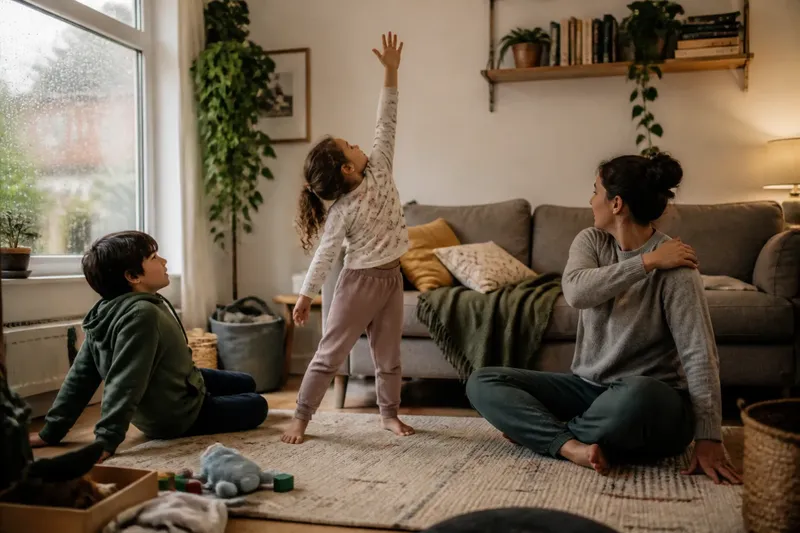
The most common mistake with a family movement trail is treating it like a course everyone has to complete. That can make a rainy afternoon feel like one more household assignment. Start with a different rule: passing is an ordinary choice, and a trail can be useful even if someone only picks the next prompt.
For a family movement trail, choose a format that suits the room and the people in it: a few stationary prompts, a simple imaginary journey, or a menu people can browse. Think of each prompt like a window left open, not a door everyone must walk through.
Which trail format fits your room?
Stationary prompts work in a small living room because nobody has to travel between stops. Use familiar landmarks, such as the sofa or a rug edge, and invite a reach, a shoulder roll, or a slow shift of weight nearby.
An imaginary journey gives a loose sequence without requiring a physical route. A family might imagine walking through a garden: reach for a branch, look under a leaf, and pause to listen. Each person can suggest what happens next or interpret the scene with a small movement.
A prompt menu suits a group with different moods or preferences. Put a few ideas on scraps of paper, or say them aloud; each person can choose, change, watch, or pass. Unlike a sequence, the menu does not make the group wait for a turn to finish.
Say you have a compact living room, a child eager to copy, and an adult who wants a calm activity. Start with three spoken prompts: reach toward an imaginary branch, turn your shoulders as if looking around a tree, and pause to listen for birds. The child can make larger gestures while the adult stays seated and moves only their hands. Either can pass on a prompt; the result is a short shared activity without a route to cross or a matching pace to maintain.
How can you set up prompts without making a course?
Use words and places already in the room instead of adding floor markers or props. A sofa can be the “tree,” and the open space beside it can be a spot to pause. Keep bags, toys, pet bowls, and other loose items out of the area people might use. Leave heavy furniture where it is.
Make each invitation easy to understand and offer an alternative in the same breath. “Reach overhead, reach forward, or move just your fingers” gives people choices without asking them to explain why they prefer one.
- Reach: Check whether the suggested reach feels comfortable; if it does, reach toward an imaginary branch, and if it does not, reach forward or move your fingers instead.
- Turn: Check whether turning the torso feels comfortable; if it does, look slowly to one side and then the other, and if it does not, turn your head or choose a hand gesture.
- Shift: Check whether standing feels comfortable; if it does, shift weight gently between the feet, and if it does not, lean slightly from a seated position or pass.
- Make a shape: Check which body shape feels easy; if a tall or wide shape feels comfortable, try it, and if not, make a smaller shape with your hands.
- Travel: Check whether the path is clear; if it is, take a few quiet steps between room landmarks, and if it is not, stay in place and move your arms.
- Pause: Check whether someone wants a turn; if they do, offer a quiet moment to listen or watch, and if they do not, let them pass without prompting them again.
These are invitations, not instructions to perform a particular way. A child might reach like a giraffe; an adult might simply loosen a shoulder. Both choices can fit the prompt.
When does an imaginary journey help?
A story can link a handful of movements without making them feel like separate tasks. Keep the scene familiar and easy to change. For a pretend garden, someone might reach toward a branch, glance beneath a leaf, step around an imagined puddle, then pause for birdsong.
Build in different ways to respond. A person who would rather not crouch can look beneath the leaf with a small head turn; someone who does not want to move can add the next detail to the story. If pretend play feels awkward for an older child or adult, describe the same actions plainly: reach, look, step or pause.
How do you keep the invitation optional?
Say at the outset that people may join, watch, choose a prompt, or pass. Do not make someone’s choice a reason to stop the activity or to ask for an explanation. In a shared room, that gives a tired or distracted person a way to stay nearby without being put on the spot.
Avoid prompts built around speed, endurance, or copying someone precisely. If people want to add a playful twist, invite them to invent a new shape or make the next movement quieter. The point is to give the group something to try, not to rank how anyone does it.
How can you adjust the trail to the space and group?
Before starting, check the area from where participants will actually be: standing, seated, or at a child’s height. Look for loose toys, sharp corners near the route, and obstacles that could trip someone. If the space feels cramped, keep everyone near their own spot rather than sending them across the room.
Offer alternatives as part of every prompt, not as a special exception. “Reach up, reach forward, or choose a hand movement” makes room for different comfort levels without asking anyone to explain. Follow relevant equipment instructions and local safety guidance where they apply; for personal health concerns, ask a qualified professional.
Which questions help you choose a family movement trail?
How long should a family movement trail last?
Let attention and comfort decide when to stop. A few prompts may be enough, and anyone can leave the activity without waiting for the group to finish.
Can a family movement trail work without props?
Yes. Spoken prompts, familiar room landmarks, and imagined objects can suggest reaching, turning, stepping, or pausing. Keeping the floor clear can make the format simpler to share.
What if someone does not want to join?
Let them watch, choose what happens next, or pass. Keep their place in the shared room separate from whether they take part in the movement.
How do you keep the activity from feeling like exercise?
Mix small movements with stillness and make choices available at each prompt. Skip targets such as matching another person or completing a set sequence.
Which format should you choose today?
Choose stationary prompts if room to move is limited, an imaginary journey if a shared story helps the group respond, or a menu if people want to make separate choices. You can also let a story connect two or three prompts without turning the room into a route.
A family movement trail works best when its setup stays smaller than the decision to join. Put the words within easy reach, leave the shared path clear, and treat “pass” as a complete answer. That way, the room can return to its usual uses as soon as the group is ready.